Work

Things I've built and run

Nerve is the main thing. Around it: smaller AI builds and a few operator case studies.

What I'm building

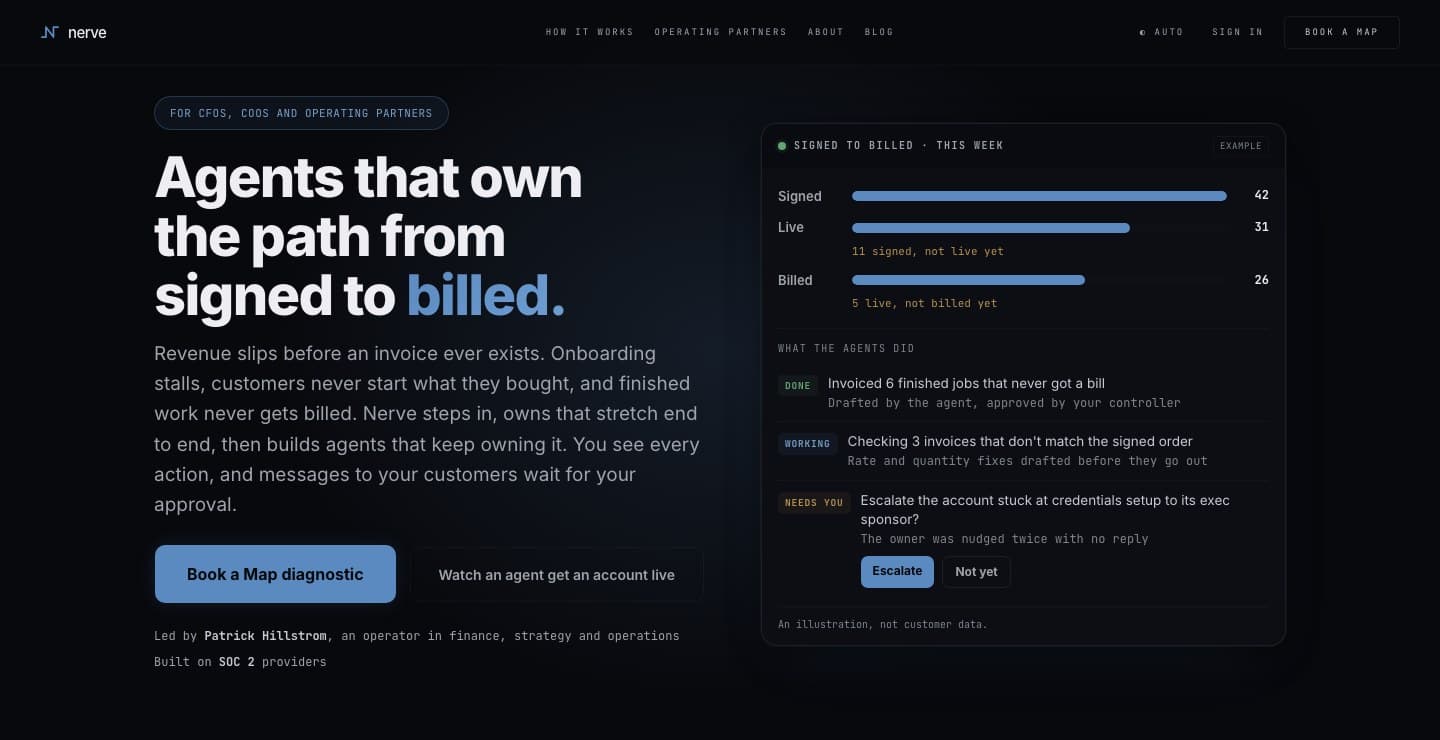
Nerve screenshot
Founder · Feb 2026 to now

Nerve: agents that own the path from signed to billed

Revenue slips between a signed deal and a correct invoice. Nerve owns that stretch end to end, then builds agents that keep owning it.

  • More than a dozen agents in production, routed by one orchestrator, outbound messages held for approval by default
  • A hosted MCP server, so Claude works from the same data as the app
  • A verification agent that ran four months inside a customer's compliance team

AI builds

2025

GPTerminal

A browser hacker sim where the model sets the puzzles and grades the solutions.

Terminal UILLM as game master
Private build, write-up only
2025

GPT.Me

A deployable AI version of your professional self that anyone can talk to.

Agentic resume
Private build, write-up only
2025

WhisperAI

A real-time overlay that reads expression, tone, and posture on video calls.

MultimodalReal time

How I build models

I've built models from both sides of the table: a buyout model from my private equity years and an operating model for a B2B data platform. One was built to price a deal and the other to manage cash month to month, but the build order is the same. Drivers come first, then the builds that turn them into dollars, then statements that mostly just link, with checks on top. The principles below come straight from those files, and the case studies walk through each model.

  1. 01

    Build revenue from the funnel

    Revenue comes from the things that physically produce it, so every input is something an operator can argue with. In the deal model that meant visits, pageviews, ad impressions per page, fill rate and price per thousand for each property; in the operating model, marketing spend turned into leads, opportunities, bookings and then billings by cohort.

  2. 02

    Start from actuals

    The deal model grew each forecast month off the same month a year earlier, seeded from a trailing-twelve-month base, so seasonality carried through without a separate curve. The operating model looked up every actual month from ledger exports by account code and date, so closing a month meant pasting a new export and the forecast picked up from there.

  3. 03

    One switch for scenarios

    Cases sit side by side and a single dropdown picks the active one, through nested IFs in the deal model and INDEX/MATCH in the operating model. The builds read that active column, so changing the story means changing one cell.

  4. 04

    Builds calculate, statements link

    The income statement is almost all links into the builds, receivables and payables come from days outstanding, and the cash flow statement runs off balance sheet changes. When I roll up to quarters and years, flows get summed and balances take the period-end value.

  5. 05

    It has to tie

    Both balance sheets carry a check row in every period, and cash is tested against the cash flow statement as well. Iteration stays off: the deal model runs interest on opening balances with a typed principal schedule, and the operating model sizes its option pool top-up off pre-top-up shares so nothing loops.

  6. 06

    Make the exit an input

    Exit year is one input and every exit row is gated on it, so the exit can move without rewiring anything. Proceeds then run through the real capital structure, with seller notes and a preferred return ahead of a management profits interest in the buyout, and SAFEs converting into a priced round in the operating model.

  7. 07

    Format for the reviewer

    Blue is a typed input, black is math, green is a link from another tab, and yellow marks the switches and cells you're meant to touch. Nearly every forecast row in both models is one formula copied end to end, so a reviewer can check the first cell and trust the rest of the row.

Operator case studies (handmade, pre-AI)

From the before times, one pivot table at a time.